
Weeks 1–2
Pain
Take the stab out of the mornings.
Hands-on work on the arch and calf, taping, and a look at what you’re standing in all day, starting your first visit.
What We Treat
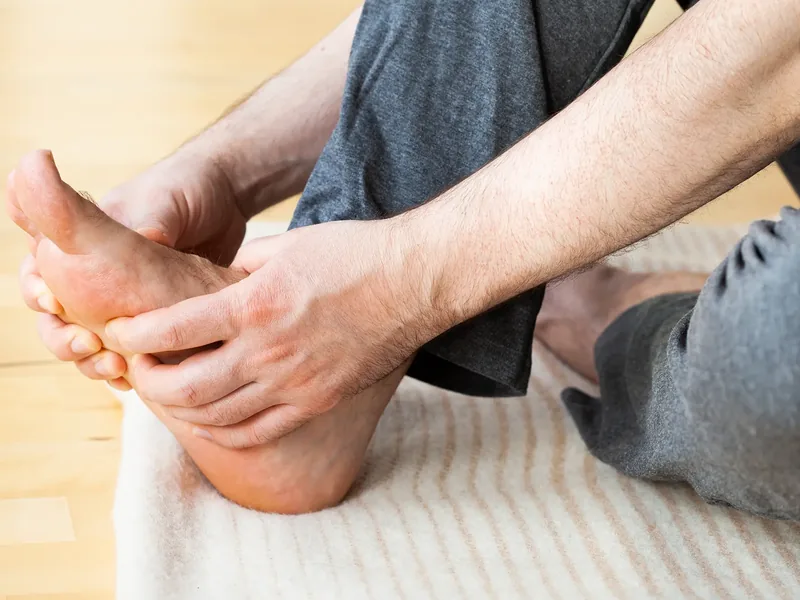
The first steps out of bed that feel like a nail through the heel. It eases once you get going, which is exactly why it’s been on your list for a year. A cause-first evaluation finds what is loading that heel.
Sound Familiar?
Two or more? Keep reading.
Why It Happens
The plantar fascia is a thick band running from your heel bone to your toes. It holds the arch up every time you push off. When the load through it outruns what it can currently tolerate, it gets irritated right where it anchors on the heel. Overnight it settles short. Your first steps stretch it cold and stiff, and that is the stab. Ten minutes later it has warmed up, so you get on with your day and the cycle repeats tomorrow.
Which is why it keeps coming back. The usual suspects sit above and behind the heel: a tight calf, a stiff big toe, foot muscles that lost their strength, and a sudden jump in walking, standing or new shoes. Heel spurs get blamed constantly and often are not the culprit at all. You have walked it off for a year because something more urgent kept coming up. A cause-first evaluation finds which of those is actually loading your heel.
The Honest Truth
Nobody regrets starting too early. Every week you wait, the compensations get one more week of practice.
How We Fix It
Every plan has an endpoint. Here’s what the four phases look like for plantar fasciitis.
Weeks 1–2
Pain
Hands-on work on the arch and calf, taping, and a look at what you’re standing in all day, starting your first visit.
Weeks 2–6
Prime
We win back length in the calf and motion in the big toe, so the fascia stops absorbing the whole push-off by itself.
Weeks 6–10
Perform
Loaded calf and foot strengthening, done slowly and heavily enough to actually change what the tissue can tolerate.
Weeks 10+
Prevent
Walking, standing and running volume gets built back on purpose, with the warning signs written down: that’s the endpoint, not just another appointment.
Dr. Moskowitz helped me with several problems -Balance, heel pain and strengthening muscles. He is knowledgeable and caring.
Shared by Rose K. · Plantar Fasciitis
Heel pain, plus balance and muscle strength that had slipped alongside it
All of it worked through, by someone she calls knowledgeable and caring
Questions, Answered
Some heels do settle on their own. The ones that have been like this for months usually don’t, because whatever overloaded the tissue is still there every morning. That is why plantar heel pain has a reputation for dragging on: the longer it stays irritated, the longer it takes to calm. You don’t need a scan first, and you don’t need a referral. Ohio is a direct-access state, so you can book an evaluation and find out where you actually stand.
Not when the dose is right. With this one, loading the tissue properly is the treatment, not the risk. Rolling a ball under the arch and stretching feels good for an hour. Slow, heavy calf and foot work is what changes how much the fascia can actually tolerate. Some soreness while you build is expected. A heel that is worse the next morning means we pushed too far, and we walk the dial back. A licensed physical therapist sets that dose at your evaluation and adjusts it with you every visit.
At the evaluation you get a realistic number of visits for your plan, plus the criteria you have to hit to finish it. A full plan runs all four phases, Pain, Prime, Perform, and Prevent, usually across 6–10 weeks, and a heel that has been sore for a year or more tends to sit at the longer end. Either way you get a plan with an endpoint. You’ll always know which phase you’re in and what is left, instead of an open-ended string of appointments.
Book Your Visit
Request a time and a real person calls you back during clinic hours. No phone tree. No ‘someone will reach out.’ Just a plan.
5.0 · 110 Google reviews
A real person calls, never an autoresponder
Step 1 of 5
That’s the hard part done. We’ll call during business hours to lock in your time and confirm your benefits before you come in.
Visit Us